Overview
Note
AI Context
Complexity: Low – This is reference documentation describing VoIPBin’s system architecture. No API calls are specific to this section.
Cost: Free. Architecture documentation is informational only; no operations are performed.
Async: N/A. This section documents the platform structure, not API endpoints.
This page describes VoIPBin’s high-level system architecture, including the three major layers (API gateway, microservices, real-time communication) and core design principles. Relevant when an AI agent needs to understand the overall platform structure, service categories, or technology stack choices.
VoIPBin is a cloud-native Communication Platform as a Service (CPaaS) built on modern microservices architecture. The platform provides comprehensive communication capabilities including PSTN calls, WebRTC, SMS, conferencing, AI-powered features, and workflow orchestration.
VoIPBin is designed from the ground up for scalability, reliability, and developer productivity, enabling businesses to build sophisticated communication solutions through simple API calls.
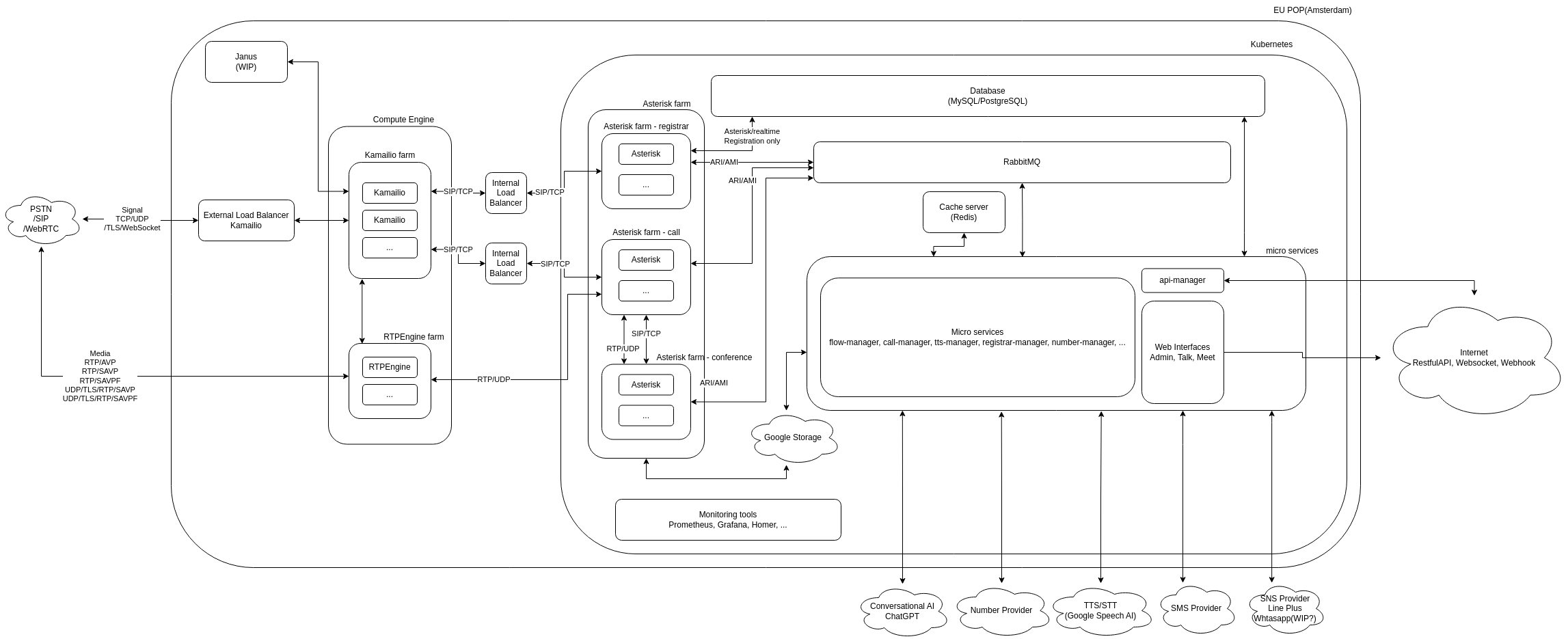
High-Level System Architecture
VoIPBin consists of three major architectural layers:
+----------------------------------------------------------------------+
|                      Client Applications                             |
|  (Web Apps, Mobile Apps, Server-to-Server Integrations)              |
+------------------------+---------------------------------------------+
                         | HTTPS/REST API
                         v
+----------------------------------------------------------------------+
|                     API Gateway Layer                                |
|                    (bin-api-manager)                                 |
|  o Authentication & Authorization                                    |
|  o Rate Limiting & Throttling                                        |
|  o Request Routing & Load Balancing                                  |
+------------------------+---------------------------------------------+
                         | RabbitMQ RPC
                         v
+----------------------------------------------------------------------+
|                  Microservices Layer                                 |
|  +--------------+  +--------------+  +--------------+                |
|  | Call Manager |  | Flow Manager |  |  AI Manager  |                |
|  +--------------+  +--------------+  +--------------+                |
|  +--------------+  +--------------+  +--------------+                |
|  |Chat Manager  |  | SMS Manager  |  |Queue Manager |                |
|  +--------------+  +--------------+  +--------------+                |
|  +--------------+  +--------------+  +--------------+                |
|  |Agent Manager |  | Billing Mgr  |  |Webhook Mgr   |                |
|  +--------------+  +--------------+  +--------------+                |
|                    ... 34 services                                   |
+------------------------+---------------------------------------------+
                         |
                         v
+----------------------------------------------------------------------+
|              Real-Time Communication Layer                           |
|  +--------------+  +--------------+  +--------------+                |
|  |  Kamailio    |  |   Asterisk   |  |  RTPEngine   |                |
|  | (SIP Proxy)  |  |(Media Server)|  |(Media Proxy) |                |
|  +--------------+  +--------------+  +--------------+                |
+----------------------------------------------------------------------+

+----------------------------------------------------------------------+
|                  Shared Infrastructure                               |
|  o MySQL Database  o Redis Cache  o RabbitMQ  o Kubernetes           |
+----------------------------------------------------------------------+
Architectural Layers
1. API Gateway Layer
The API Gateway (bin-api-manager) serves as the single entry point for all external requests:
Authentication: JWT-based authentication for all API requests
Authorization: Permission checks based on customer and agent roles
Request Routing: Routes authenticated requests to appropriate backend services via RabbitMQ RPC
Protocol Translation: Converts HTTP/REST to internal RabbitMQ messaging
Response Aggregation: Collects responses from backend services and returns to clients
2. Microservices Layer
VoIPBin consists of 34 specialized Go microservices, organized by domain:
Communication Services: * bin-call-manager: Call lifecycle and routing * bin-conference-manager: Conference bridge management * bin-message-manager: SMS messaging * bin-talk-manager: Real-time chat
AI Services: * bin-ai-manager: AI assistant, transcription, summarization * bin-transcribe-manager: Speech-to-text processing * bin-tts-manager: Text-to-speech synthesis
Workflow Services: * bin-flow-manager: Call flow orchestration and IVR * bin-queue-manager: Call queue management * bin-campaign-manager: Outbound campaign automation
Management Services: * bin-agent-manager: Agent state and presence * bin-billing-manager: Usage tracking and billing * bin-webhook-manager: Webhook delivery * bin-storage-manager: File and media storage
3. Real-Time Communication Layer
See RTC Architecture for detailed information about the VoIP stack.
Core Design Principles
VoIPBin is designed around these key architectural principles:
Microservices Architecture
Service Isolation:
+------------+     +------------+     +------------+
|  Service A |     |  Service B |     |  Service C |
|            |     |            |     |            |
|  o Domain  |     |  o Domain  |     |  o Domain  |
|  o Logic   |     |  o Logic   |     |  o Logic   |
|  o Data    |     |  o Data    |     |  o Data    |
+------+-----+     +------+-----+     +------+-----+
       |                  |                  |
       +------------------+------------------+
                Message Queue (RabbitMQ)
Domain Isolation: Each service owns its domain logic and data
Independent Deployment: Services can be deployed independently
Technology Flexibility: Services can use different technologies as needed
Fault Isolation: Failure in one service doesn’t cascade
Event-Driven Architecture
Event Flow:
+--------------+     Event        +--------------+
|   Service    |----------------> |   Message    |
|  (Publisher) |                  |    Queue     |
+--------------+                  +-------+------+
                                          |
                                          +----------------+
                                          |                |
                                          v                v
                                 +------------+   +------------+
                                 | Subscriber |   | Subscriber |
                                 | Service A  |   | Service B  |
                                 +------------+   +------------+
Asynchronous Communication: Services communicate via events
Loose Coupling: Publishers don’t know about subscribers
Scalability: Multiple subscribers can process events in parallel
Reliability: Message queues provide guaranteed delivery
API Gateway Pattern
External Request Flow:

Client App                  API Gateway              Backend Services
    |                           |                           |
    |  HTTPS/REST               |                           |
    +--------------------------->                           |
    |                           |  1. Authenticate          |
    |                           |  2. Authorize             |
    |                           |  3. Route Request         |
    |                           |                           |
    |                           |  RabbitMQ RPC             |
    |                           +--------------------------->
    |                           |                           |
    |                           |  Response                 |
    |                           <---------------------------+
    |  JSON Response            |                           |
    <---------------------------+                           |
    |                           |                           |
Single Entry Point: All external traffic goes through one gateway
Security Layer: Authentication and authorization at the edge
Protocol Translation: HTTP to internal messaging protocols
Service Discovery: Gateway knows how to reach all services
Shared Data Layer
Data Architecture:

+------------+  +------------+  +------------+
|  Service   |  |  Service   |  |  Service   |
|      A     |  |      B     |  |      C     |
+------+-----+  +-------+----+  +--------+---+
       |                |                |
       +----------------+----------------+
       |                |                |
       v                v                v
+-------------------------------------------+
|           Redis Cache (Hot Data)          |
+-------------------------------------------+
       v                v                v
+-------------------------------------------+
|         MySQL Database (Cold Data)        |
+-------------------------------------------+
Shared MySQL: Single source of truth for all data
Redis Cache: Fast access to frequently used data
Consistent Schema: All services use common database schema
Transaction Support: ACID guarantees for critical operations
Communication Channels
VoIPBin supports multiple communication channels through dedicated gateways:
Voice Communication:
PSTN: Traditional phone calls via carrier integrations
WebRTC: Browser-based voice calls
SIP: Direct SIP trunking for enterprise customers
Messaging:
SMS: Text messaging via carrier integrations
Chat: Real-time chat with WebSocket support
Email: Email notifications and campaigns
AI-Enhanced Communication:
AI Assistants: Voice-enabled AI agents for customer service
Transcription: Real-time and batch speech-to-text
Summarization: Call summarization and insights
Sentiment Analysis: Real-time emotion detection
Integration Capabilities
VoIPBin provides multiple integration methods:
REST API:
Comprehensive REST API for all platform features
OpenAPI/Swagger documentation
SDKs for multiple languages
WebSocket:
Real-time event streaming
Bi-directional media streaming
Live transcription feeds
Webhooks:
Event notifications to external systems
Configurable retry policies
Signature verification for security
Direct Database Access:
Read replicas for reporting
Analytics database for business intelligence
Key Architectural Benefits
VoIPBin’s architecture is designed to deliver these advantages:
Scalability
Horizontal Scaling: Add more service instances to handle increased load
Independent Scaling: Scale only the services that need more capacity
Auto-Scaling: Kubernetes automatically scales based on metrics
Global Distribution: Deploy services across multiple regions
Reliability
Fault Isolation: Issues in one service don’t affect others
Circuit Breakers: Prevent cascading failures
Automatic Failover: Kubernetes restarts failed containers
SIP Session Recovery: Maintain calls even when servers crash
Message Persistence: RabbitMQ ensures no messages are lost
Security
API Gateway Security: All authentication at the edge
Service Isolation: Services communicate via internal network only
Encryption: TLS for all external communication
Secret Management: Kubernetes secrets for sensitive data
Audit Logging: Complete audit trail of all operations
Developer Productivity
Simple REST API: Easy to integrate with any application
Comprehensive Docs: Detailed documentation with examples
Webhook Events: Real-time notifications of system events
Test Environment: Sandbox for development and testing
SDK Support: Official SDKs for popular languages
Operational Excellence
Centralized Logging: All logs aggregated in one place
Metrics & Monitoring: Prometheus metrics for all services
Distributed Tracing: Track requests across services
Health Checks: Automated health monitoring
Zero-Downtime Deploys: Rolling updates without service interruption
Service Dependencies
VoIPBin services have well-defined dependencies for coordinated operations:
Core Service Dependencies:

+-----------------------------------------------------------------+
|                     bin-api-manager                             |
|                    (API Gateway)                                |
|  -------------------------------------------------------------  |
|    Depends on: ALL backend services for RPC routing             |
+-----------------------------------------------------------------+
                             |
     +-----------------------+-----------------------+
     |                       |                       |
     v                       v                       v
+-------------+        +-------------+        +-------------+
|bin-call-mgr |        |bin-flow-mgr |        |bin-ai-mgr   |
+------+------+        +------+------+        +------+------+
       |                      |                      |
       |                      |                      |
       v                      v                      v
+-------------+        +-------------+        +-------------+
|bin-billing  |        |bin-call-mgr |        |bin-transcribe|
|bin-webhook  |        |bin-queue-mgr|        |bin-tts-mgr  |
|bin-number   |        |bin-ai-mgr   |        |bin-pipecat  |
+-------------+        +-------------+        +-------------+
Key Dependency Patterns:
Call Processing Chain:
bin-call-manager
  +--> bin-flow-manager      (IVR and call flows)
  +--> bin-billing-manager   (usage tracking)
  +--> bin-webhook-manager   (event notifications)
  +--> bin-transcribe-manager (call transcription)
  +--> bin-number-manager    (phone number lookup)

AI Voice Pipeline:
bin-pipecat-manager
  +--> bin-ai-manager        (LLM coordination)
  +--> bin-call-manager      (call control)
  +--> bin-transcribe-manager (STT)

Flow Orchestration:
bin-flow-manager
  +--> bin-call-manager      (call actions)
  +--> bin-queue-manager     (queue operations)
  +--> bin-ai-manager        (AI interactions)
  +--> bin-conference-manager (conference bridges)

Infrastructure Monitoring:
bin-sentinel-manager
  +--> bin-call-manager      (SIP session recovery events)
Circular Dependencies:
VoIPBin avoids circular dependencies through:
Event-Driven Decoupling: Services publish events, others subscribe
Gateway Orchestration: API Gateway coordinates cross-service operations
Shared Data Layer: Services share data via MySQL, not direct calls
Technology Stack
VoIPBin is built on modern, proven technologies:
Backend Services:
Language: Go (Golang) for all microservices
API Framework: Gin for HTTP routing
RPC: RabbitMQ for inter-service communication
Database: MySQL for persistent storage
Cache: Redis for session and hot data
Real-Time Communication:
SIP Proxy: Kamailio for SIP routing
Media Server: Asterisk for call processing
Media Proxy: RTPEngine for RTP handling
Infrastructure:
Container Runtime: Docker for containerization
Orchestration: Kubernetes (GKE) for container management
Cloud Provider: Google Cloud Platform
Monitoring: Prometheus + Grafana for metrics
Logging: ELK stack for centralized logging
Message Queue:
Broker: RabbitMQ for async messaging
Event Bus: RabbitMQ pub/sub events; in-process fan-out inside the API gateway for WebSocket delivery
This architecture enables VoIPBin to deliver enterprise-grade communication services at scale while maintaining developer simplicity and operational excellence.